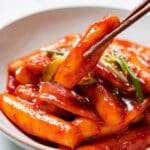
Description
Tteokbokki is a popular Korean street food featuring chewy rice cakes stir-fried in a spicy, slightly sweet gochujang-based sauce. This recipe uses anchovy broth for depth and includes fish cake, cabbage, and scallions to balance textures and flavors. Perfectly chewy and richly flavored, this classic dish is a comforting and spicy treat that’s easy to prepare at home.
Ingredients
Scale
Main Ingredients
- 1 pound tteokbokki tteok 떡볶이 떡 (about 24 3-inch long rice cake pieces)
- 1–2 eomuk 어묵 (fish cake) sheets
- 4 ounces green cabbage (yangbaechu, 양배추)
- 1–2 scallions
- 1 tablespoon minced garlic
Anchovy Broth
- 8–10 medium to large dried anchovies (마른멸치), about 0.5 ounces (15 grams)
- 1 piece dasima (dried kelp), about 3-inch square
- 1/4 medium onion, roughly sliced
- 5 cups water (for making broth)
Tteokbokki Sauce
- 3 cups anchovy broth or water (use 4 cups for more sauce)
- 3 tablespoons gochujang, 고추장
- 1–3 teaspoons finely ground gochugaru, 고추가루
- 1 tablespoon soy sauce
- 2 tablespoons sugar (use 1 tablespoon for less sweet)
- 1 tablespoon corn syrup (or oligo syrup; increase sugar if omitted)
Optional
- 2 boiled eggs
Instructions
- Soak Rice Cakes: Soak the tteokbokki rice cakes in water for about 20 minutes to soften them. This time can be extended if using refrigerated rice cakes.
- Prepare Ingredients: Cut the fish cake, cabbage, and scallions into approximately 2-inch long pieces to ensure even cooking and ease of eating.
- Make Anchovy Broth: In a large pan, combine dried anchovies, dasima, and sliced onion with 5 cups of water. Bring to a boil over medium-high heat and maintain boiling for 10 minutes to extract flavors. Reduce heat if necessary to avoid excessive boiling. Remove anchovies, kelp, and onion from broth to keep it clear.
- Add Sauce Ingredients: Add the gochujang, gochugaru, soy sauce, sugar, and corn syrup to the broth in the pan. Stir thoroughly to dissolve the gochujang evenly, creating a smooth, spicy sauce base.
- Cook Rice Cakes: Add soaked rice cakes to the pan. Boil until the rice cakes become very soft and the sauce thickens, approximately 8 to 10 minutes. Stir frequently to prevent sticking and ensure even cooking. This time may vary depending on the rice cakes’ freshness.
- Add Vegetables and Fish Cake: Add the cut cabbage, minced garlic, and fish cakes to the pan. Continue to boil and stir occasionally for an additional 4 to 6 minutes until the vegetables are tender and the rice cakes reach desired softness. Add more broth or water if the sauce reduces too much.
- Finish and Serve: Drop in the scallions and optional boiled eggs with 2 to 3 minutes remaining. Taste the sauce and adjust seasoning as needed. Serve hot immediately for the best flavor and texture.
Notes
- Tteokbokki rice cakes can be found fresh, refrigerated, or frozen at Korean markets. Use fresh locally made rice cakes if available for best texture; otherwise, refrigerated or frozen can be used.
- For a variation on the sauce, try 2 tablespoons gochujang, 2 tablespoons finely ground gochugaru, and 1.5 tablespoons soy sauce. This creates a cleaner-tasting and spicier sauce.
- Finely ground gochugaru works best in this recipe. Grind regular gochugaru in a spice grinder or sieve for optimal texture.
- Tteokbokki does not reheat well in the microwave. Warm any leftovers in a small pan with a little broth or water over low heat to restore texture and flavor.
Nutrition
- Serving Size: 1 cup (approximate)
- Calories: 320 kcal
- Sugar: 12 g
- Sodium: 780 mg
- Fat: 4 g
- Saturated Fat: 0.5 g
- Unsaturated Fat: 3 g
- Trans Fat: 0 g
- Carbohydrates: 65 g
- Fiber: 2 g
- Protein: 6 g
- Cholesterol: 15 mg
